Top 5 Wireless Guitar Systems for Stage and Practice in the US (2026)
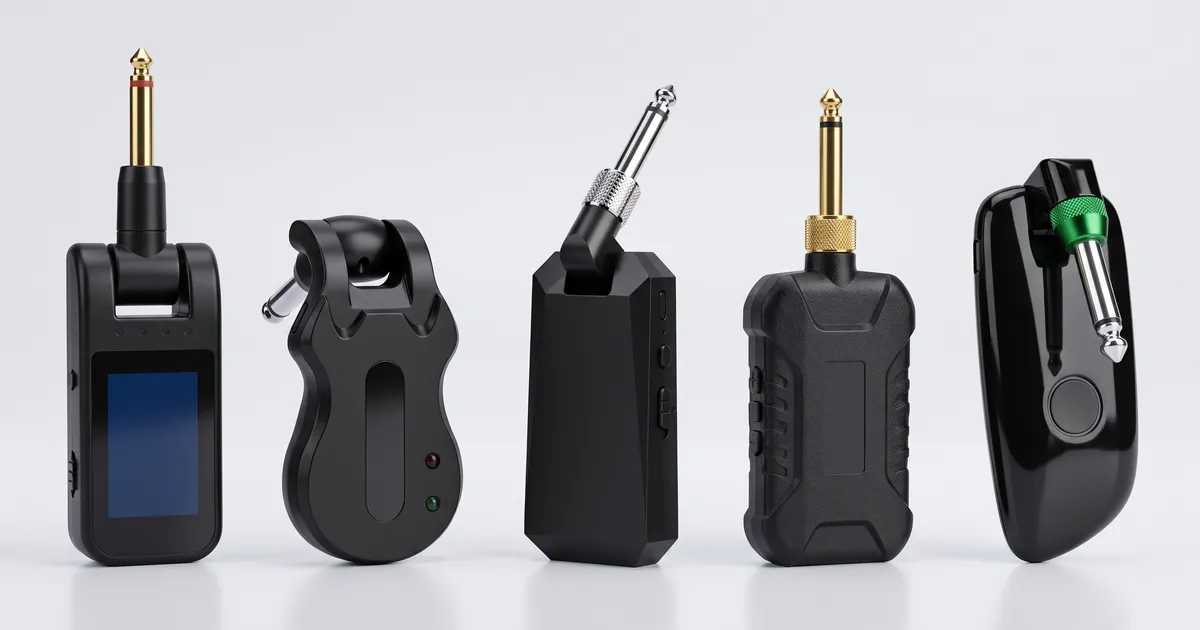
“I'm able to walk around my apartment without needing to take off my bass or unplug to take care of something across the room. That alone is enough for me to justify it.”
— Ross N. · Amazon buyer
You plug in to practice across the room, but a trailing cable catches on your pedalboard and jerks your instrument. Tossing the cord away gives you freedom of movement, yet finding a dependable transmitter often feels complicated. Many players dread the moment an unstable signal cuts out during a live set.
Choosing the right setup is tricky because technical spec sheets rarely reveal real-world transmission issues. Buyers describe units with a muffled tone, and transmitters that fade or drop out as the battery runs low. When a battery fades unexpectedly mid-song, the entire performance suffers.
We read what buyers report about daily reliability, latency during tracking, and active pickup performance. We set what buyers report beside each listing's specs.
How this list was built
The editor placed the first pick; what the page says about it comes from its own product page. The other wireless guitar systems were chosen by how much buyers bought, reviewed and rated them, one per brand, in the same price band, then the editor read what their buyers report, quoted exactly as written; nothing is claimed beyond those reviews and the listings' own specifications.
By the numbers
- Buyers
- 15
- Listings
- 4
- Reviews quoted
- 16
- Picks
- 5
How the shortlist was drawn
- The editor’s pick firstThe first pick was placed first by the editor; the other picks were chosen by the stated rule from products in the same price band.
- The editor's ruleThe other picks were chosen by how much buyers bought, reviewed and rated them, one per brand.
- Sold new on Amazon USEvery pick after the first was listed new and in stock on Amazon US, with a price, when this guide was built.
What each pick was judged on
- DAW UsageOwners report on how responsive the transmitter feels when tracking into digital audio workstations and recording software.
- Charging CaseTransmitters are evaluated on whether bundled storage docks provide reliable protection and quick field recharging.
- Folded PositionReviews show whether swivel plugs stay firmly in their folded position during active stage movement.
- Prices are not listed. They move constantly and a stale number helps nobody — the retailer shows what it costs right now.
Here are the 5, in the editor's order.
The editor placed the first pick. The other picks were chosen by the stated rule from products in the same price band; TrueValuePick earns nothing from any link. How a guide is put together.
Our top 5 picks
No. 1
InsMazid Pro

The InsMazid Pro sends 48K/16-bit audio over a 2.4GHz connection, and its store page gives up to 131 feet (40 meters) of range, or 66 feet (20 meters) through walls. Its 282-degree rotating plug fits 6.35mm jacks at different angles.
The system supports up to eight sets running at the same time on separate channels. The page lists up to ten hours of playing per charge and about two hours to charge fully, and the box holds a transmitter, a receiver, a USB cable and a user manual.
Pros
- Offers a wide 282-degree rotation angle for diverse jack angles
- Supports up to eight device groups operating at the same time
- Provides transmission distance up to 131 feet, or 66 feet through walls
- Up to ten hours of playing per charge, the store page says
- Delivers 48K/16-bit digital audio
Cons
- Requires a two-hour charge time to reach full capacity
- Lists latency as under 12 ms; other picks' listings state under 6 ms or under 2 ms
What to expect
Buyers can expect an adaptable wireless setup designed to accommodate awkward guitar jack angles thanks to its wide rotating connector. During daily rehearsals and stage use, the system transmits clear digital audio over considerable room distances without tethering the performer to an amplifier. Up to eight units can run concurrently for multi-instrumental setups. A full charge typically requires about two hours connected via USB, providing extended operating time for lengthy practice sessions.
Our conclusion
This system provides 282-degree rotation and 48K digital transmission for players who need multi-device flexibility. Its main trade-off is a two-hour charge time to refill its battery.
No. 2
LEKATO Wireless Guitar System

This 5.8GHz system fits players who track into software or play instruments loaded with hot active preamps. One reviewer notes that it delivers clean transmission for DAW usage without latency issues in recording sessions.
The hardware features a firm pivot that holds its folded position securely against the guitar. Another owner reports that it works clearly with active EMG pickups, though low battery levels cause volume drops at the amplifier.
Pros
- Tracks without latency or lag during DAW recording sessions
- Operates with firm pivot positioning so units stay folded
- Features a power switch located on the side for convenient access
- Delivers clear audio when paired with active EMG pickups
Cons
- Causes guitar and amplifier volume to drop when battery level runs low
What owners say
Greg Gillette · Amazon buyer
I love the power switch being on the side of the unit so no turning over to locate to turn on and off and the pivot on each unit is nice and firm so it holds its folded position and wont flop around.
Amazon Customer · Amazon buyer
There is 100% a tone difference between the joyo and these and also my other ones the others all have a slight muffled sound to them which wasn't noticed until I plugged into the lekato. I couldn't believe the difference! And they work waaaaaaay better with active emg pickups!
Josh Silva · Amazon buyer
Note when battery is low, you will notice that the guitar and amp sound low and you turn up volume and then you realize it’s the battery.
Jerry Guzman · Amazon buyer
No lag/latency issues whatsoever from instrument to plugins into Logic Pro recordings/sessions. Great for DAW usage in my experience so far.
Our conclusion
This setup suits players tracking into digital setups thanks to its firm positioning and clean response with active pickups. A reported drawback is that diminishing battery power quietly lowers amplifier output volume.
No. 3
Getaria Wireless Guitar System WP-3

The Getaria WP-3 is built for players who want a simple plug-and-play cordless setup. One musician notes that it plugs straight into a Fender Stratocaster with no clearance problems. Sound transmission remains free of feedback during practice.
A fully charged set provides at least two solid hours of continuous playing. However, another owner points out that the transmitter begins to disconnect repeatedly once battery power dips near empty.
Pros
- Plugs into Fender Stratocaster jacks without fitting problems
- Operates without feedback or interference issues during playing
- Provides two hours of continuous playing time on a full charge
Cons
- Begins disconnecting on and off when battery level runs low
What owners say
dave3064 · Amazon buyer
The sound quality is very good. I cannot tell the difference between being plugged in or wireless. I have not had any feedback or interference issues.
Peter J O'Neal · Amazon buyer
If both the transmitter and receiver are fully charged, you can get a solid two hours minimum of straight playing.
Tommy · Amazon buyer
The battery life's not that great. When they get low and battery , they start disconnecting off and on.
Our conclusion
This model is ideal for Stratocaster players who want straightforward wireless operation with no feedback issues. The primary catch is that depleted batteries cause intermittent signal dropouts.
No. 4
JOYO Wireless Guitar System JW-06

This JOYO model appeals to musicians who prioritize compact storage and quick portable charging. An owner likes that the charging case saves hassle in charging and storage and takes up little space.
One buyer has a router and a Fire TV in the same room and has noticed no dropouts. One buyer noticed identical audio performance compared to a wired pedalboard cable, though another user experienced a unit losing charge after thirty minutes.
Pros
- Includes a compact charging case that saves space and simplifies storage
- Resists interference when operating in rooms with routers and streaming hardware
- Maintains identical sound quality when integrated with pedalboard setups
Cons
- Suffered reduced battery longevity after six months of light use
What owners say
Riley · Amazon buyer
Further, I really really like the " airpods" style charging case that they come in, It saves a lot of hassle in terms of charging and storage, and it doesn't take up a ton of space which is nice.
OzValen · Amazon buyer
One of the units doesn’t hold a charge for more than a half hour. The last set I bought didn’t have the charger dock. After about 6 months of light use one of the units quit holding a charge very long either.
Dean R · Amazon buyer
I have my fireTV and router in the same room and haven't noticed any dropouts nor interference. And the plug-in units themselves are nice and small.
W. Balser · Amazon buyer
I have used this with a pedal board and can hear no difference between a wired connection and wireless.
Our conclusion
This pick suits players practicing near home routers who want a compact storage case. Its main compromise is that one owner reported a unit failing to hold charge after light use.
No. 5
SWIFF AUDIO Wireless Guitar System

The SWIFF AUDIO unit serves gigging players and apartment musicians who want immediate setup. One owner took the system to multiple club gigs and rehearsals, reporting quiet audio free of static. Pairing requires only a single button press on each component.
Musicians can walk freely across rooms without unplugging their instruments. Even so, one buyer noticed the receiver unit stopped holding power for more than forty-five minutes after regular playing sessions.
Pros
- Operates quietly across multiple club gigs and rehearsals without static
- Pairs in seconds with a single button press on both units
- Enables freedom of movement around rooms without unplugging instruments
Cons
- Lost ability to hold a charge beyond forty-five minutes
What owners say
Ross N. · Amazon buyer
I'm able to walk around my apartment without needing to take off my bass or unplug to take care of something across the room. That alone is enough for me to justify it.
Brendan · Amazon buyer
I've already taken my original unit to five club gigs and four rehearsals and it has performed incredibly well. No interference, no static. Perfectly quiet.
Cherie · Amazon buyer
Super simple to set up, just press the button for a second on each one after they are plugged in and BAM done.
William · Amazon buyer
In the last week I realized the receiver was not holding a charge for more than 45 minutes.
Our conclusion
This system suits gigging musicians wanting rapid one-button setup and quiet audio on stage. The primary trade-off is that an owner experienced diminished battery runtimes under an hour.
Buying guide
Frequency Bands and Signal Stability
Selecting the right frequency band prevents unwanted interference during rehearsal. Many modern setups operate on 5.8GHz or UHF channels to avoid crowded household networks. Players report that higher frequency bands avoid signal dropouts when playing near home wireless routers.
Jack Fit and Body Clearance
Instrument jacks vary widely from flat top plates to angled Stratocaster cups. Transmitters with rotating plugs adjust easily to sit flush against the body. A sturdy hinge ensures firm positioning so your transmitter never sags or interferes with the volume knob while you play.
Battery Management on Stage
Built-in batteries need to sustain full rehearsal sessions without sudden dropouts. Several designs include a dedicated storage dock for recharging between sets. When battery power drops too low, owners notice that signal level fades or the transmitter starts disconnecting abruptly.
Mistakes buyers keep making
Drawn from what buyers complain about in their reviews.
Ignoring active pickup levels
One listing advises lowering a hot instrument's volume to prevent distortion from too strong an input.
Overlooking low battery symptoms
Transmitters often drop overall volume or cut audio intermittently when cell voltage dips below operating thresholds.
Neglecting jack clearance
Check that the plug fits a recessed or angled jack; several listings say theirs fit recessed jacks and guitars with a vibrato system.
Frequently asked questions
Do wireless guitar systems introduce noticeable lag?
Listings here state latency under 12 ms, under 6 ms or under 2 ms, and one buyer reports no lag at all recording into Logic Pro.
Will wireless systems work with active EMG pickups?
Certain transmitters handle high-output active pickups cleanly. However, some models produce a slightly muffled tone or require rolling back guitar volume to prevent input clipping.
How do you know when the battery is running low?
Owners report that fading batteries cause instrument output volume to drop quietly or lead to intermittent disconnections before the transmitter turns off entirely.
Can multiple wireless systems operate in the same room?
Yes. Most units offer multiple selectable channels or device groups, allowing several musicians to broadcast simultaneously without signal crosstalk.
Do home Wi-Fi routers interfere with 5.8GHz systems?
Transmitters running on 5.8GHz generally avoid crowded 2.4GHz home bands. Owners report clean performance even when practicing in the same room as streaming devices and routers.
Are rotatable transmitter plugs safe for Stratocaster jacks?
One buyer's unit plugs straight into a Fender Strat with no problems, and the InsMazid's plug rotates 282 degrees to suit angled jacks.
How were these picks chosen?
The editor placed the first pick; its description comes from its own product page. The other picks were chosen by how much buyers bought, reviewed and rated them, one per brand; they were listed new and in stock on Amazon US, in the same price band, when the guide was built, and every quote on this page is an excerpt of a buyer's own review of that product, copied word for word. The site tests nothing itself.

Kevin Larson
Editor, Audio guides
Kevin Larson covers audio gear for TrueValuePick, building each guide from what owners report in public about the headphones, speakers and earbuds they listen with.
Compiled this guide from buyer reviews, each one checked against an archived copy of the listing it came from.